
















 (1)-20251204034946188.jpg)













Welcome to OSCAL (A China brand of TWS earbuds, rugged phone, tablet, and portable power station) blog. Hope this guide has been helpful.
If you’ve been shopping for wireless earbuds lately, you’ve probably noticed the term “ANC” popping up everywhere. It’s often highlighted as a premium feature, promised to make your listening experience more immersive, more peaceful, and more focused. But what does ANC actually mean, and why has it become such a big deal in modern earbuds?
In this guide, we’ll break down what ANC means in earbuds, how it works, the different types you might encounter, and whether it’s really worth paying extra for. By the end, you’ll have a clear understanding of whether ANC earbuds fit your lifestyle—or if standard earbuds might already be enough for your needs.
What does ANC stand for?
ANC stands for Active Noise Cancellation. In simple terms, it’s a technology designed to reduce unwanted background sounds around you. Unlike basic earbuds that rely only on physical design to block noise, ANC uses electronics and sound processing to actively cancel out external noise.
This is especially useful in environments with consistent background noise, such as airplane cabins, buses, trains, busy offices, or cafés. With ANC enabled, you can listen to music, podcasts, or calls at lower volumes while still hearing clearly.
How does ANC work in earbuds?
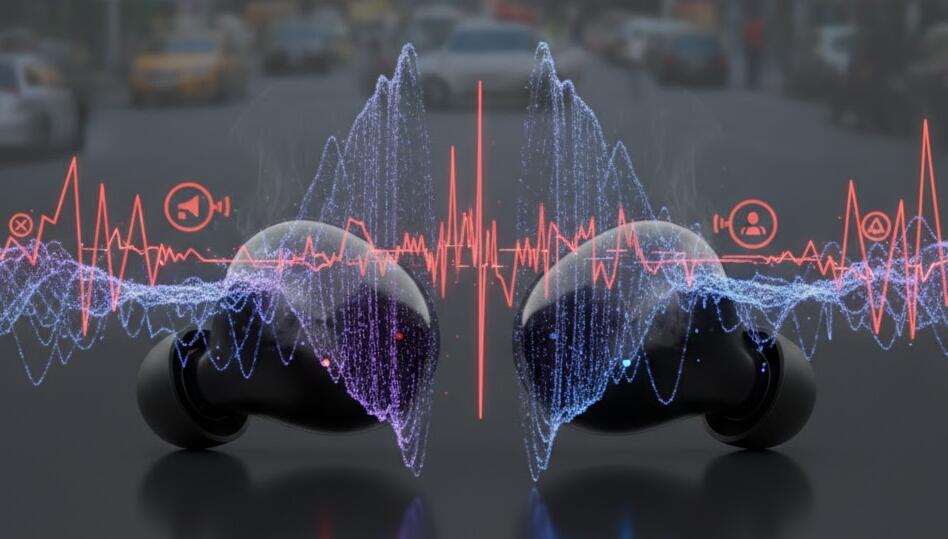
Active Noise Cancellation works by using tiny microphones built into the earbuds. These microphones constantly listen to the sounds around you. Once external noise is detected, the earbuds generate a sound wave that is the exact opposite (or “anti-noise”) of that noise.
When the original sound wave and the anti-noise wave meet, they cancel each other out. This process happens extremely fast—thousands of times per second—so you don’t notice any delay. The result is a significantly quieter listening environment, even though you’re still surrounded by noise.
Active noise cancellation vs passive noise isolation
It’s easy to confuse ANC with passive noise isolation, but they’re not the same thing. Passive noise isolation depends on the physical design of the earbuds, such as silicone ear tips that create a seal in your ear canal. This seal blocks some external sounds naturally.
ANC, on the other hand, is an active electronic process. Many earbuds actually use both methods together: passive isolation to reduce higher-frequency sounds, and ANC to cancel out lower, constant noises like engine hums or air conditioning.
Types of ANC you may see in earbuds
Not all ANC systems are identical. Depending on the earbuds, you may encounter different types or combinations of noise cancellation:
- Feedforward ANC: Microphones are placed on the outside of the earbuds to detect noise before it enters your ear.
- Feedback ANC: Microphones are placed inside the ear canal to detect the noise that actually reaches your ear.
- Hybrid ANC: Combines both feedforward and feedback microphones for more accurate and effective noise cancellation.
Hybrid ANC is generally the most effective but also tends to appear in higher-end earbuds.
What kinds of noise does ANC reduce best?
ANC is most effective at reducing low-frequency, steady sounds. These include airplane engine noise, train rumble, road noise, fans, and HVAC systems. These sounds are predictable and consistent, making them easier for ANC algorithms to cancel.
Sudden or high-frequency sounds—like people talking, dogs barking, or dishes clattering—are harder to eliminate completely. While ANC can reduce their intensity, it won’t usually remove them entirely.
Does ANC affect sound quality?
This depends on the quality of the earbuds and how well the ANC is implemented. In well-designed earbuds, ANC can actually improve perceived sound quality by removing background noise that would otherwise mask details in your music.
However, poorly implemented ANC may introduce a slight hiss, pressure sensation, or changes in sound tuning. Many modern earbuds allow you to toggle ANC on or off so you can choose the sound profile you prefer.
Battery life and ANC
Because ANC relies on microphones and constant processing, it does consume extra battery power. Earbuds with ANC typically have shorter battery life when noise cancellation is turned on compared to when it’s off.
That said, battery technology has improved significantly. Many ANC earbuds now offer several hours of playback with ANC enabled, plus additional charges from the case.
When should you use ANC earbuds?
ANC earbuds are especially useful if you:
- Travel frequently by plane, train, or bus
- Work or study in noisy environments
- Want to focus without distractions
- Prefer listening at lower volumes to protect your hearing
If you mostly listen at home in quiet spaces, ANC may be less essential—but still nice to have.
Are ANC earbuds worth it?
Whether ANC earbuds are worth the extra cost depends on your lifestyle and priorities. If background noise regularly interferes with your listening experience, ANC can feel like a game-changer. It can reduce fatigue, improve clarity, and make everyday listening more enjoyable. Featured products: #officeworks wireless earbuds, #wireless earbuds for gym, #ipx7 earbuds
On the other hand, if you rarely encounter noisy environments or are on a tight budget, standard earbuds with good passive isolation may be perfectly sufficient.
Final thoughts
ANC in earbuds stands for Active Noise Cancellation, a technology that actively reduces unwanted background noise using microphones and sound waves. It’s particularly effective for low, constant sounds and has become a defining feature of many modern wireless earbuds.
Understanding what ANC does—and what it doesn’t do—helps you make a smarter buying decision. Whether you choose ANC earbuds or not, the best option is always the one that fits your listening habits, environment, and comfort preferences.


