
















 (1)-20251204034946188.jpg)















Welcome to OSCAL (Well-known China brand of tablets, rugged smartphones, and portable power stations) blog. Hope this guide has been helpful.
The mobile network world is full of confusing terms, and few are as commonly misunderstood as 4G+ and 5G. Many users see the “+” symbol on their phone screen and assume they are already enjoying next-generation speeds. Others believe 4G+ is simply another name for 5G. In reality, while these technologies are related, they are not the same.
This guide will clearly explain what 4G+ and 5G actually mean, how they differ, and which one is right for your needs. By the end, you will understand the technical differences, real-world performance, and future potential of both technologies without needing an engineering background.
What Is 4G+?
4G+ is also known as LTE-Advanced (LTE-A). It is an enhanced version of standard 4G LTE rather than a completely new generation. The main goal of 4G+ is to squeeze more performance out of existing 4G infrastructure using smarter techniques.
Typical advantages of 4G+ include:
- Higher download and upload speeds than standard 4G
- Improved network efficiency in crowded areas
- Better support for HD video streaming and online gaming
Learn more about 4G+.
What Is 5G?
5G is the fifth generation of mobile network technology and represents a major leap forward rather than an incremental upgrade. It was designed not only for faster smartphones but also for new use cases such as smart cities, autonomous vehicles, and massive Internet of Things (IoT) deployments.
Unlike 4G+, 5G uses a wide range of frequency bands, including low-band, mid-band, and high-band (millimeter wave). Each band serves a different purpose, balancing coverage, speed, and latency.
Key characteristics of 5G include:
- Extremely high peak speeds, often exceeding 1 Gbps
- Ultra-low latency, sometimes under 10 milliseconds
- Ability to connect far more devices simultaneously
5G networks also rely on advanced technologies such as massive MIMO (multiple-input, multiple-output) and beamforming, which help direct signals more precisely to users.
Speed Comparison: 4G+ vs 5G
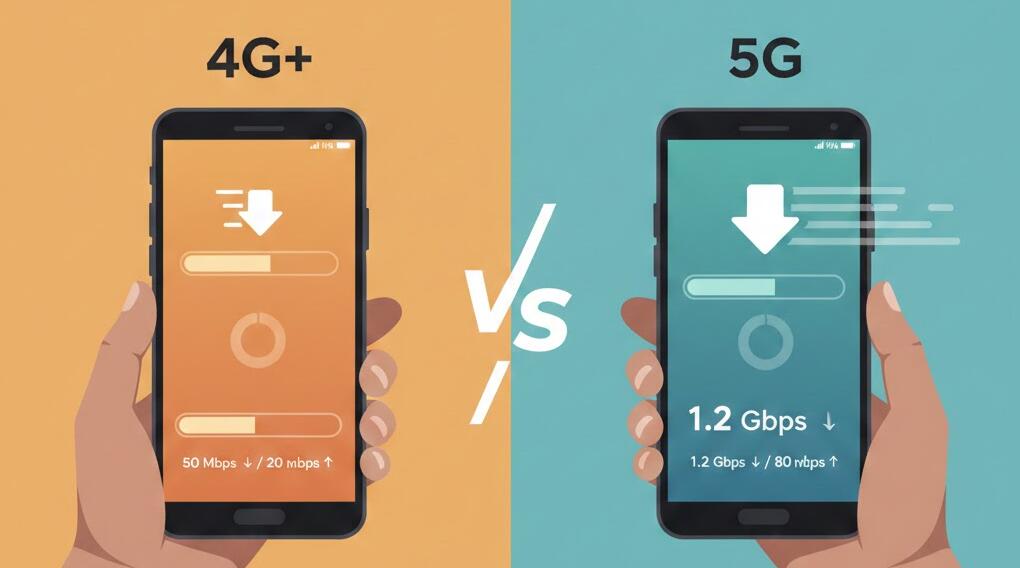
Speed is the most obvious difference between 4G+ and 5G, but it is also the most misunderstood. While 4G+ is faster than regular 4G, it still cannot match the performance ceiling of 5G.
In everyday use, a strong 4G+ connection may deliver download speeds between 50 and 150 Mbps. This is more than enough for streaming, browsing, and most mobile tasks. 5G, on the other hand, can easily surpass 300 Mbps in real-world conditions and may reach much higher speeds in well-covered areas.
However, speed alone does not tell the whole story. Consistency and responsiveness are just as important, especially for real-time applications.
Latency and Responsiveness
Latency refers to how quickly data travels between your device and the network. Lower latency means faster response times. This is where 5G truly separates itself from 4G+.
While 4G+ typically has latency between 30 and 50 milliseconds, 5G can reduce this to under 10 milliseconds in optimal conditions. This improvement enables applications such as cloud gaming, remote surgery, and real-time augmented reality, which are difficult or impossible on 4G+.
Coverage and Availability
Despite its technical advantages, 5G coverage is still expanding in many regions. 4G+ benefits from years of infrastructure development and is widely available, even in rural or less densely populated areas.
In contrast, 5G coverage can be uneven. High-band 5G offers incredible speed but has limited range and struggles with obstacles like walls. Low-band 5G covers larger areas but may not feel dramatically faster than 4G+.
This means that in some locations, a stable 4G+ connection may actually provide a better experience than a weak or congested 5G signal.
Device Compatibility
Most modern smartphones support 4G+, but 5G requires specific hardware. Older devices cannot be upgraded to 5G through software alone. If your phone does not support 5G bands, it will automatically fall back to 4G or 4G+.
Additionally, not all 5G phones support every 5G frequency band. This can affect performance when traveling between regions or switching carriers.
Are 4G+ and 5G the Same?
The short answer is no. 4G+ is an advanced form of 4G, while 5G is a completely new generation. They may feel similar during basic tasks, but under the surface, they are built for different futures.
4G+ focuses on improving current mobile experiences, whereas 5G is designed to support entirely new industries and technologies. Calling them the same would be like comparing a faster highway to a high-speed rail system.
Conclusion
Choosing between 4G+ and 5G depends largely on your location, device, and usage needs. For many users, 4G+ still offers excellent performance and reliability. It is mature, widely available, and capable of handling most daily mobile activities with ease.
5G, however, represents the future of connectivity. As coverage improves and more applications take advantage of its low latency and high capacity, its benefits will become increasingly noticeable. Understanding the difference between 4G+ and 5G allows you to make smarter decisions about devices, data plans, and expectations as mobile technology continues to evolve.