


































 (1)-20251204034946188.jpg)


















Welcome to OSCAL (Well-known Chinese brand of Android tablets, rugged smartphones, and portable power stations) blog. Hope this guide has been helpful.
Finding suitable tablet games for 2-4 year olds can be challenging because young children need simple controls, clear visuals, and age-appropriate content. At this age, games work best when they feel like playful activities rather than complicated challenges with complicated rules or fast reactions. A good tablet game can introduce colors, shapes, numbers, sounds, animals, and basic problem-solving skills while keeping children interested.
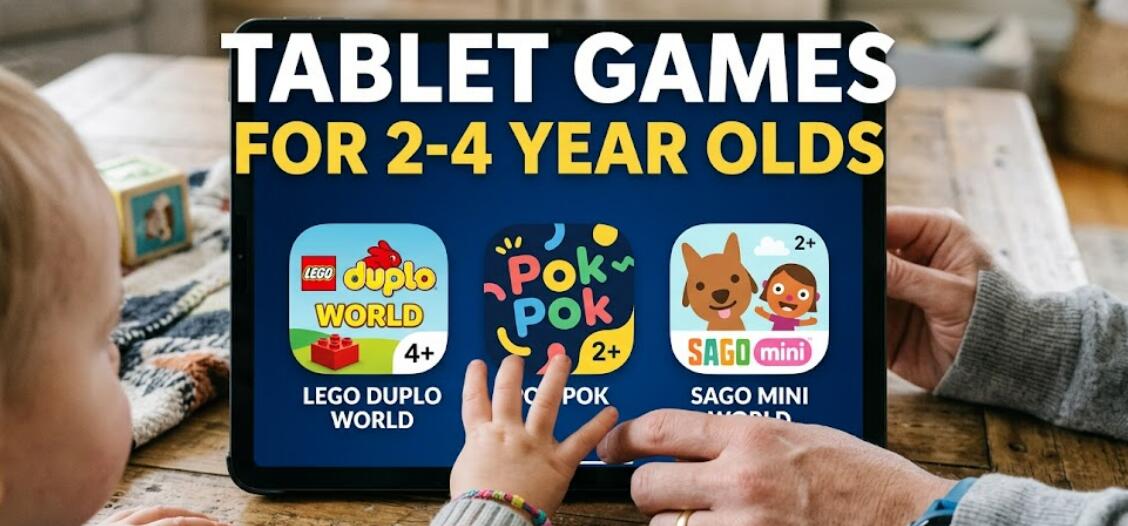
The best games for toddlers and preschoolers are easy to understand and allow children to explore at their own pace. Parents should also consider whether a game contains advertisements, in-app purchases, confusing menus, or features that may distract from learning. The following eight tablet games are good options to consider when you want entertaining and developmentally appropriate activities for children between two and four years old.
The 8 Best Tablet Games at a Glance
- LEGO DUPLO World
- Khan Academy Kids
- Pok Pok
- Sago Mini World
- Endless Alphabet
- Peekaboo Barn
- Busy Shapes
- Moose Math
1. LEGO DUPLO World
LEGO DUPLO World is designed around the large, colorful building blocks that are familiar to many young children. The app provides interactive activities involving animals, vehicles, buildings, numbers, and everyday environments. Children can tap, drag, build, and explore different scenes without needing to understand complicated instructions.
For children around two to four years old, the game's biggest advantage is its emphasis on open-ended exploration. Rather than requiring advanced reading skills, it uses visual prompts and interactive objects to encourage children to experiment. Activities can also introduce early concepts such as counting, matching, colors, and simple problem-solving.
The familiar LEGO-style presentation can make the experience especially appealing to preschoolers. Parents can play alongside their children and use the scenes as opportunities to ask questions, such as which animal they see or how many objects are on the screen.
2. Khan Academy Kids
Khan Academy Kids is a broad educational app offering activities for young learners. It includes early literacy, mathematics, drawing, reading, and social-emotional learning activities. The content is presented through colorful characters, stories, songs, and interactive exercises.
For two-year-olds, parents may want to guide children toward the simplest activities, while three- and four-year-olds can explore more of the available learning content. The app gradually introduces concepts such as letters, numbers, shapes, counting, and vocabulary.
One useful feature is the variety of activities. A child can move from a short educational exercise to a story or creative activity rather than staying focused on one type of task for too long. This variety can make learning feel more like play.
3. Pok Pok
Pok Pok takes a quieter approach to tablet play. Instead of traditional levels, scores, or competitive challenges, it offers digital toys and open-ended activities that children can explore independently. The visual design is simple, making it easier for young children to understand what they can interact with.
The app is particularly suitable for parents who prefer imaginative play rather than highly stimulating games. Children can experiment with different objects, discover cause and effect, and create their own play scenarios.
Because there is no need to rush toward a particular goal, Pok Pok can encourage patience and independent exploration. Parents can also use the activities as starting points for conversations about colors, sounds, shapes, and everyday experiences.
4. Sago Mini World
Sago Mini World combines numerous preschool activities into one child-friendly environment. Children can explore characters and locations, participate in imaginative scenarios, and interact with objects through simple taps and swipes.
The game is well suited to preschoolers because the controls are generally straightforward. Children can explore without having to read long instructions or understand complex game mechanics. Different activities can encourage pretend play, creativity, observation, and simple decision-making.
For a two-year-old, parents may need to demonstrate how some activities work. Older preschoolers can often explore more independently. The colorful characters and playful environments also give parents opportunities to talk with children about emotions, animals, transportation, food, and other familiar subjects.
5. Endless Alphabet
Endless Alphabet introduces children to letters and vocabulary through animated characters and playful word activities. Instead of treating alphabet learning as memorization alone, the app combines letters with simple words and colorful animations.
Children can interact with letters by moving them into the correct positions to complete words. After completing a word, they can see an animation that helps explain its meaning. This combination of sound, movement, and visual information can make new vocabulary easier for preschool children to remember.
Endless Alphabet is particularly appropriate for children closer to three or four years old, although younger children can still enjoy the animations and sounds. Parents can reinforce the learning experience by saying the letters and words aloud together with the child.
6. Peekaboo Barn
Peekaboo Barn is a very simple game focused on animals and sounds. Children interact with a barn and discover animals hiding inside. Each animal is introduced through a recognizable sound and visual image.
The simplicity of the game makes it especially suitable for younger toddlers. Children do not need to read, understand complicated instructions, or complete difficult puzzles. Instead, they can practice recognition and learn the names and sounds of familiar animals.
Peekaboo-style activities can also support early communication. Parents can ask children to identify the animal, imitate its sound, or name its color. These small interactions can turn a short tablet session into a shared learning activity.
7. Busy Shapes
Busy Shapes focuses on early spatial reasoning and problem-solving. Children manipulate objects and attempt to place them into matching spaces. The concept is straightforward, but it encourages children to think about size, shape, position, and movement.
This type of activity can be particularly useful for preschoolers because it does not depend heavily on reading. Children learn by experimenting with objects and seeing what happens when they move them around the screen.
Busy Shapes can also help develop hand-eye coordination. Younger children may need assistance at first, while older preschoolers can gradually become more independent as they understand the matching process.
8. Moose Math
Moose Math introduces early mathematics through colorful characters and interactive activities. Children can practice counting, addition, subtraction, sorting, and other foundational concepts through short game-like exercises.
Although the mathematical content can be more appropriate for children approaching preschool age, parents can select activities according to their child's current ability. The playful format helps prevent basic counting exercises from feeling like formal schoolwork.
For children aged three or four, Moose Math can be a useful way to reinforce concepts they are already learning at home or preschool. Parents can also use the game as a starting point for practicing numbers away from the tablet.
What Makes a Good Tablet Game for Young Children?
A good game for two- to four-year-olds should have simple controls and an interface that children can understand without constant adult assistance. Large buttons, clear images, gentle animations, and limited text are generally helpful for this age group.
Games should also provide meaningful interaction rather than simply encouraging children to tap the screen repeatedly. Activities involving matching, counting, drawing, building, storytelling, and exploration can provide more opportunities for children to think and respond.
Educational Skills Children Can Practice
Tablet games can support several early learning skills when used appropriately. Alphabet games can introduce letter recognition and vocabulary, while counting games can reinforce numbers and basic mathematical ideas. Shape and puzzle games can encourage spatial reasoning and problem-solving.
Creative and open-ended games can support imagination and decision-making. Games involving animals, stories, and characters can also encourage children to develop language by naming objects, describing actions, and answering questions.
How Parents Can Make Tablet Play More Useful
Parents do not need to sit beside their children during every minute of tablet use, but occasional participation can make digital play more valuable. Ask questions about what the child is doing, repeat new words, count objects together, or encourage the child to explain what happens on the screen.
For example, if a game introduces several animals, parents can ask the child which animal is largest, what sound it makes, or where the animal might live. These conversations connect digital activities with real-world learning.
Screen-Time Tips for Ages 2-4
Tablet games should be only one part of a young child's daily activities. Children also need opportunities for physical movement, outdoor play, creative activities, reading, social interaction, and hands-on exploration.
Parents can establish simple routines around tablet use, such as playing after another activity or stopping at a predetermined time. It is also useful to keep notifications turned off and avoid games that constantly encourage children to continue playing.
How to Choose Safe Tablet Games
Before installing a game, parents should check its age rating, privacy practices, advertising, and in-app purchase options. A child-friendly game should have an interface that does not make it easy for a young child to accidentally purchase something or open unrelated content.
Parents should also review the game themselves before giving it to a child. Spending a few minutes exploring the menus can reveal whether the app contains advertisements, external links, unnecessary permissions, or features that may not be appropriate for toddlers and preschoolers.
Final Thoughts
The best tablet games for 2-4 year olds are not necessarily the most complicated or visually intense. Simple games that encourage exploration, creativity, language, counting, matching, and problem-solving can provide a better experience for young children. LEGO DUPLO World, Khan Academy Kids, Pok Pok, Sago Mini World, Endless Alphabet, Peekaboo Barn, Busy Shapes, and Moose Math each offer different ways for children to learn while playing.
Ultimately, the ideal tablet experience depends on the individual child's age, interests, and developmental stage. Choosing age-appropriate games, setting reasonable boundaries, and occasionally playing together can help turn tablet time into a positive and purposeful part of a child's routine.


