






































 (1)-20251204034946188.jpg)

















Welcome to OSCAL (Well-known Chinese brand of Android tablets, rugged outdoor smartphones, and portable power stations) blog. Hope this guide has been helpful.
Tablet performance can slow down when too many apps are running, storage space is nearly full, or the device has limited memory. Although physical RAM cannot normally be upgraded on most modern tablets, there are several ways to make better use of the available RAM and, on supported devices, use storage as virtual memory.
- Read also: How to turn on your tablet without power button?
- How to fix a tablet that is not connecting to wifi?
- How to fix tablet not responding to touch?
Increasing usable RAM is particularly helpful when a tablet frequently reloads apps, freezes during multitasking, or struggles with demanding games and productivity tools. The exact options depend on the tablet model, operating system, and manufacturer, but the following methods can help improve memory performance without replacing the device.
Can You Physically Increase Tablet RAM?
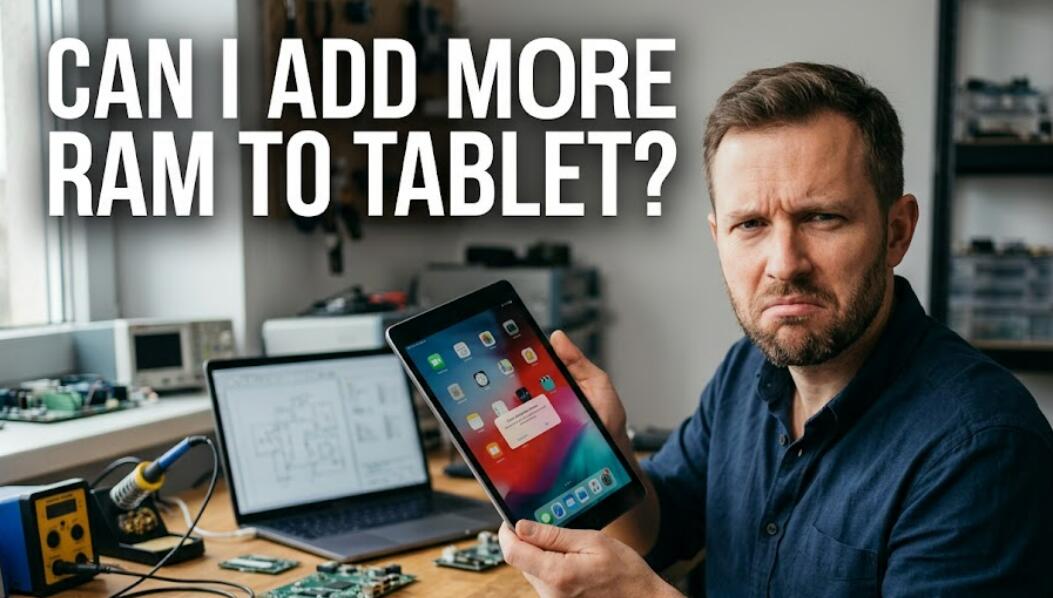
For most Android tablets and nearly all iPads, the physical RAM is soldered to the motherboard and cannot be replaced or expanded like a desktop computer's memory module. Therefore, you generally cannot open the tablet and install a larger RAM chip.
Instead, focus on freeing existing memory, reducing unnecessary background activity, and using a virtual RAM feature if your tablet supports it.
Use Virtual RAM or Memory Expansion
Some Android tablets include a feature called Virtual RAM, RAM Plus, Memory Extension, or a similar name. It uses part of the tablet's internal storage as additional memory when physical RAM becomes limited. Storage is slower than actual RAM, so this does not provide the same performance as installing more physical memory, but it can help with multitasking.
- Open Settings on your tablet.
- Search for RAM, Virtual RAM, or Memory Extension.
- Open the corresponding memory settings.
- Choose the amount of storage you want to allocate, if options are available.
- Confirm the setting and restart the tablet if requested.
If you cannot find this option, your tablet may not support virtual RAM. Do not install questionable third-party applications that claim to physically increase RAM, because they cannot add actual memory hardware.
Close Unnecessary Background Apps
Running numerous applications simultaneously can consume available RAM. Closing apps that you are not using can make more memory available for the applications that matter.
- Open the recent apps screen.
- Review applications currently running.
- Close apps that you no longer need.
- Avoid repeatedly closing essential system applications unless necessary.
Android generally manages RAM automatically, so you do not need to constantly clear every application. Focus on apps that use significant memory or continue running unnecessary background processes.
Uninstall Apps You No Longer Use
Unused applications can consume storage and may perform background tasks or receive updates. Removing unnecessary apps can reduce background activity and give the operating system more room to work.
- Open Settings.
- Go to Apps or App Management.
- Select an application you no longer use.
- Tap Uninstall and confirm.
Keep Enough Free Storage
Internal storage and RAM are different types of memory, but keeping storage reasonably free can help overall system performance. This is especially important when your tablet uses storage-based virtual RAM.
Delete unnecessary videos, downloads, duplicate photos, and large files. You can also move important media to cloud storage or another storage device when appropriate.
Reduce Resource-Heavy Features
Widgets, animated backgrounds, synchronization services, and demanding applications can increase system activity. Removing unnecessary widgets and limiting background activity can help tablets with modest RAM perform more smoothly.
You can also review notification and background-permission settings for applications that you rarely use. Restricting unnecessary activity may reduce memory pressure and improve battery life at the same time.
Restart the Tablet Regularly
A restart can clear temporary processes and give the operating system a fresh start. If your tablet becomes unusually slow after extended use, restarting it may restore smoother performance without deleting your personal files.
Upgrade the Tablet When Necessary
If your tablet has permanently limited physical RAM and continues to struggle after optimization, hardware limitations may be the main issue. In that situation, upgrading to a newer tablet with more physical RAM is usually more effective than relying on memory-management applications.
Before buying a replacement, check the RAM capacity, processor, storage, and software support rather than judging performance by RAM alone. A well-optimized tablet with sufficient physical memory can provide a much better multitasking experience.
Conclusion
You usually cannot physically increase the RAM of a tablet because the memory is integrated into its hardware. However, you can improve available memory by enabling virtual RAM when supported, closing unnecessary background apps, uninstalling unused apps, and maintaining sufficient free storage.
These methods can make a noticeable difference on tablets that struggle with multitasking. If performance remains poor despite optimization, the most reliable long-term solution is a device with more physical RAM and stronger hardware.